Gas vs Electric Patio Heaters: A Commercial Buyer’s Guide
A practical comparison of gas and electric patio heaters for hospitality buyers, covering site conditions, utilities, operating costs and a usable inquiry brief.

Choosing a gas patio heater or an electric patio heater for a restaurant is a decision about the site as much as the appliance. A heater that suits an open dining terrace may be difficult to accommodate beneath a low roof. A neat wall-mounted unit may fit the design but exceed the electrical capacity available to that part of the building.
Start with the space, available utilities and daily operating routine. Then compare individual models against that brief. For buyers sourcing outdoor patio heaters across several venues, this approach also makes quotations easier to compare: each supplier receives the same requirements.
Gas vs electric patio heaters: a quick comparison
| Buying question | Gas option | Electric option |
|---|---|---|
| What must be available? | The specified gas supply and the correct appliance configuration. | A supply matching the heater’s voltage and electrical requirements. |
| Where will it sit? | Freestanding formats need floor space and the model’s required clearances. | Wall or ceiling formats need an approved mounting position; freestanding electric models also exist. |
| What does operation involve? | For cylinder-fed models, plan cylinder handling, checks and storage. | Plan switching, any supported controls and the electrical installation. |
| How should cost be compared? | Use the selected model’s fuel consumption and local delivered fuel price. | Use electrical input, operating time and the applicable electricity tariff. |
| What determines the final choice? | The specific model, site conditions, installation instructions and destination requirements. | |
These are selection criteria, rather than a ranking of the two energy sources. Bromic’s own outdoor heating comparison also treats utilities, installation and intended use as separate considerations.
Specify outdoor heaters for restaurants by seating zone
A useful restaurant patio heater brief shows where people actually sit. Mark dining tables, lounge seating, service routes, doors and the parts of the terrace that stay unused on cooler evenings. Heating the entire footprint and providing comfort at selected tables are different project goals.
Next, record whether each zone is open to the sky, beneath a roof or affected by retractable screens. Include photographs and mounting heights. A terrace can change character when blinds are lowered; do not assume an outdoor gas appliance remains suitable after the space is enclosed.
Outdoor gas heaters must not be brought into enclosed indoor spaces. Carbon monoxide is a serious hazard from fuel-burning equipment. Fire and Rescue NSW’s guidance explains why outdoor gas heaters need outdoor use and appropriate ventilation. Follow the selected model’s instructions and the requirements that apply at the installation location.
When to shortlist a gas patio heater
Consider a freestanding gas patio heater when the layout can accommodate its base, people can move around it comfortably and the approved gas arrangement is practical. A cylinder-fed propane patio heater may be worth assessing where a fixed electrical installation is impractical, provided the site and appliance instructions permit the proposed use.
For a venue operator, the purchasing question extends beyond the heater’s appearance. Who will check the equipment? Where will cylinders be kept? How will staff manage storage after service? These tasks should be understood before ordering several units.
Specify the actual fuel configuration. A product family’s list of gas options does not mean one appliance can accept every gas without changes. Ask for the configuration, gas category, operating pressure and connection details that apply to the destination. Do not plan a fuel conversion from a catalogue description.
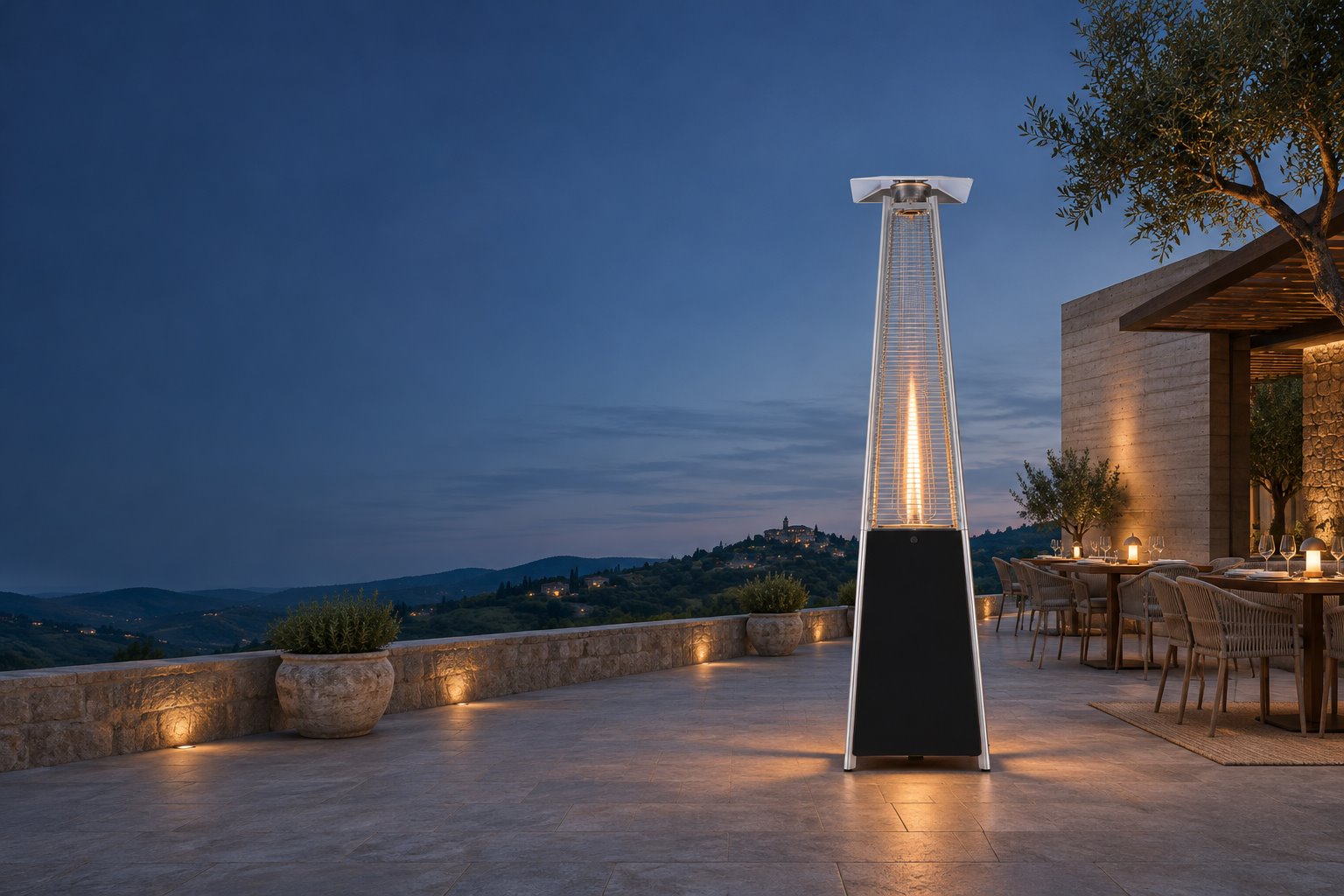
FirstSight’s Mushroom Patio Heaters and Pyramid & Hexagonal Heaters provide two starting points for comparing freestanding gas formats.
When to shortlist an electric patio heater
A mounted electric outdoor heater is worth assessing when keeping the floor clear matters and suitable mounting surfaces and electrical capacity are available. For restaurant terraces, the position must work with awnings, lighting, doors and the seating plan.
Electric does not automatically mean suitable for every covered space. Confirm outdoor suitability, permitted orientation, clearances, weather exposure and the specific mounting kit. Ask a qualified installer to check the supply and installation requirements before choosing the final model.
In FirstSight’s current catalogue, the FS-084 Series lists 1,500 W and 2,000 W variants with wall or ceiling mounting. Those figures identify options to review; they do not establish how many units a particular restaurant needs. Compare them within the wider Electric Outdoor Heaters collection.
Compare energy cost and heat output on the right basis
For an electric heater operating at a constant input, electricity use in kWh equals input in kW multiplied by operating hours. As a calculation example, a 2 kW unit running at full input for four hours uses 8 kWh. Multiply that by the relevant tariff to estimate its energy charge. This example excludes installation and other charges.
For gas, request consumption in a stated unit, such as kg per hour for the selected cylinder-fed configuration, and apply the corresponding fuel price. Do not compare a cylinder price directly with a price per kWh.
Likewise, a gas appliance’s stated heat rating and an electric heater’s electrical input do not, by themselves, predict equal comfort at a table. Ask what each rating represents and assess the proposed placement and exposure. Avoid selecting commercial patio heaters solely from the largest number in a specification table.
Send a quotation brief that suppliers can answer
Before asking a commercial patio heater supplier to quote, prepare:
- The destination country, intended use and number of sites.
- A seating plan, photographs, roof details and relevant heights.
- The available electrical supply or intended gas arrangement.
- Preferred models and quantities, with alternatives identified separately.
- The documents, installation information and spare-parts details required for review.
FirstSight is an outdoor heater factory with gas and electric product collections. Send your shortlist and site brief to discuss the model configurations and information needed for your inquiry.
Frequently asked questions
Are electric patio heaters always cheaper to run?
No universal comparison applies. The answer depends on the model’s consumption, local energy prices, operating time and how the equipment is used.
Can a gas patio heater be used under a roof?
A roof alone does not determine suitability. Check the exact appliance instructions, clearances, ventilation and local installation requirements. Do not use an outdoor-only gas heater in an enclosed indoor space.
Does “commercial patio heater” mean a model is approved for my restaurant?
No. The description is a starting point for procurement. Confirm the specific model, documents and suitability for the destination and intended installation.